
The Resurrection

Why do you seek the living among the dead? He is not here; he has risen.
—Luke 24:5-6
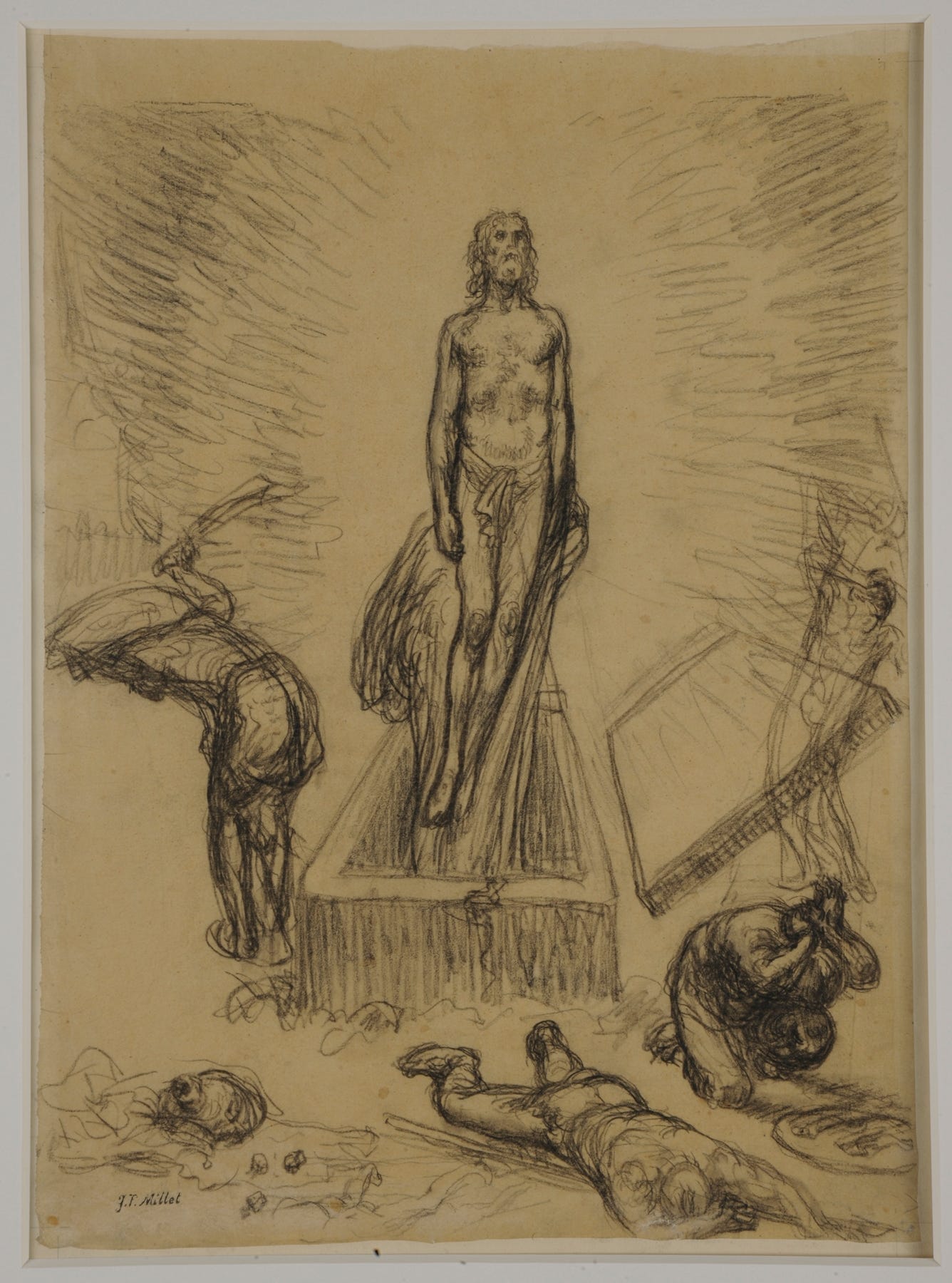
Everything depends on the resurrection. It is both Christianity’s point of origin and its most essential claim. Without it, Christianity would never have formed. A small, frightened group of people in first-century Palestine became convinced of something almost impossible to believe—and from that conviction came Christianity.
Reconstructing the resurrection as a historian is a difficult task, largely because the various accounts do not always agree on the details. The best place to begin is with Paul, since his letters are the oldest texts in the New Testament. For Paul, the resurrection is the foundation upon which everything else rests. He states plainly that without it, faith collapses entirely: If Christ has not been raised, your faith is futile, and you are still in your sins (1 Corinthians 15:17 NRSVUE). The resurrection is also, for Paul, God’s public declaration of who Jesus actually is. As he writes, Jesus was declared to be Son of God with power according to the spirit of holiness by resurrection from the dead (Romans 1:4 NRSVUE).
Most scholars date Paul’s letters to the 50s AD, placing them a few decades earlier than the Gospels. Unlike the Gospel writers, Paul had personal contact with some of the original disciples. In Galatians 1:18, he mentions traveling to Jerusalem specifically to meet Peter, staying with him for fifteen days, and also meeting James, the brother of Jesus. When Paul speaks about the resurrection, he is reporting what he received from people who were there.
It is worth noting that Paul makes no mention of Jesus’ miracles—the water turned to wine, the walking on water, the healings. But he mentions the resurrection—a lot. He treats it as the living center of everything he preaches. His most significant statement on the subject comes in 1 Corinthians 15, where he lists the appearances of the risen Jesus: to Peter, then to the Twelve, then to more than five hundred people at once, then to James, then to all the apostles, and finally to Paul himself. He even notes that most of the five hundred are still alive—almost as an invitation for his readers to go and verify the claim.
Yet for all Paul’s insistence on the resurrection, he never offers a narrative account of what actually happened that first Easter morning. That is where the Gospels come in.
Our oldest Gospel is Mark. If you open your Bible to Mark’s final chapter, you will notice it has two endings—a shorter one and a longer one. Neither is original; both were added later. The actual ending of Mark, stripped of those additions, reads as follows:
As they entered the tomb, they saw a young man dressed in a white robe sitting on the right side, and they were alarmed. But he said to them, “Do not be alarmed; you are looking for Jesus of Nazareth, who was crucified. He has been raised; he is not here. Look, there is the place they laid him. But go, tell his disciples and Peter that he is going ahead of you to Galilee; there you will see him, just as he told you.” So they went out and fled from the tomb, for terror and amazement had seized them, and they said nothing to anyone, for they were afraid. — Mark 16:5–8 NRSVUE
Whether this was Mark’s intended ending, or whether the Gospel was left unfinished, or whether the original conclusion was lost, remains a matter of scholarly debate. If this is the intended ending, it is striking that Mark chose to close without any account of Jesus actually appearing to the disciples. We are told he was raised, but we never see him. The mystery of that ending is something I have spent considerable time with, and I have not yet arrived at a confident position.
The first full narrative of the resurrection comes from Matthew then. It is, somewhat surprisingly, rather brief. Mary Magdalene and the other Mary go to the tomb, where an angel informs them that Jesus has been raised and instructs them to tell the disciples that Jesus will meet them in Galilee. As they are leaving, Jesus suddenly appears and greets them. The women take hold of his feet and worship him. Jesus then echoes the angel’s message—he will meet the disciples in Galilee. Here we see the beginning of a recurring motif: the risen Jesus appearing out of thin air, without warning.
The narrative then moves to Galilee:
Now the eleven disciples went to Galilee, to the mountain to which Jesus had directed them. When they saw him, they worshiped him, but they doubted. And Jesus came and said to them, “All authority in heaven and on earth has been given to me. Go therefore and make disciples of all nations, baptizing them in the name of the Father and of the Son and of the Holy Spirit and teaching them to obey everything that I have commanded you. And remember, I am with you always, to the end of the age.” — Matthew 28:16–20
Many readers are surprised to discover how brief Matthew’s resurrection account is, and how narratively sparse Mark’s is. Luke and John provide the longer, more detailed accounts that most people are familiar with.
One small detail in the passage above deserves attention: but they doubted. I suspect this detail, and the doubt narratives we encounter elsewhere, trace back to something historical. Not every follower of Jesus may have come to believe in the resurrection. It is even possible that not all of the original Twelve were fully convinced—which might help explain why so many of them are absent from the tradition beyond a bare mention of their names. If every disciple had wholeheartedly embraced the resurrection, it seems unlikely that these doubt traditions would have formed at all.
One more thing worth noting in Matthew’s account: here we encounter the first significant discrepancy. Paul indicates that Peter was the first to whom Jesus appeared. In Matthew, it is the two Marys. Paul is reciting a creed, which means it predates him and likely goes back to the very earliest community. And yet Matthew tells a different story.
Next comes Luke, whose resurrection account is longer and more detailed than either Mark’s or Matthew’s. This pattern of increasing detail as we move through the Gospel tradition may itself be evidence of how tradition develops over time. The further we go along the textual timeline, the richer and more elaborate the story becomes.
As in the other Gospels, it is Mary Magdalene and a group of women who go to the tomb first, where they are met by angels—two, in Luke’s account. They report what they have seen to the apostles, who do not believe them.
Jesus then makes his first appearance to an otherwise obscure disciple named Cleopas and an unnamed companion. The two do not recognize him at first. They walk with him and talk with him, but only identify him when they share a meal—and at that moment, he vanishes. The ghostly quality of these appearances is worth noting.
What follows is slightly puzzling. When Cleopas and his companion return to Jerusalem to share the news, they find the other disciples already saying that Jesus has appeared to Simon Peter. So perhaps Peter did see him first, even in Luke. The text makes it impossible to say with certainty.
Shortly after, Jesus appears among the gathered disciples. He seems to materialize out of nowhere, and his opening words are Peace be with you. The disciples are startled—Luke tells us they thought they were seeing a ghost (24:37). Again, the ghostlike quality surfaces.
Jesus then addresses them directly:
“Why are you frightened, and why do doubts arise in your hearts? Look at my hands and my feet; see that it is I myself. Touch me and see, for a ghost does not have flesh and bones as you see that I have.” And when he had said this, he showed them his hands and his feet. Yet for all their joy they were still disbelieving and wondering, and he said to them, “Have you anything here to eat?” They gave him a piece of broiled fish, and he took it and ate in their presence. — Luke 24:38–43 NRSVUE
What is significant here is that Jesus is actively working to prove he is not a ghost. This, I think, tells us something important about Luke’s theology—and perhaps about early Christian belief in general. Jesus entered an exalted state, yes, but his body got up. The resurrection is bodily, not merely spiritual. The author wants to be clear that this is different from a ghost, which is disembodied.
It is also worth noting that in Luke the disciples are gathered in Jerusalem, whereas in Mark and Matthew they had fled to Galilee, where Jesus was supposed to meet them.
John gives us the longest and theologically richest resurrection account of the four. It begins, like the others, with Mary Magdalene going to the tomb—but in John, she goes alone. She finds the stone rolled away and runs to tell Peter and the Beloved Disciple. The two race to the tomb, and we are told, with oddly specific detail, that the Beloved Disciple outran Peter. They find the burial cloths lying there, the head cloth folded separately—and then, strangely, they simply go home.
Mary stays behind, weeping. She looks into the tomb and sees two angels, then turns to find a man she takes to be the gardener. He asks why she is crying. She asks whether he has taken the body away. Then he speaks her name, and she recognizes him—it is Jesus. It is one of the most quietly intimate moments in the entire New Testament. It also creates yet another discrepancy: in John’s account, Mary is unambiguously the first to see the risen Jesus.
That evening, Jesus appears to the gathered disciples behind locked doors. As in Luke, he arrives without warning, and as in Luke, his first words are Peace be with you. But then he does something Luke does not include—he breathes on them and says, Receive the Holy Spirit. In Luke, the Spirit does not come until Pentecost, weeks later.
Then comes the famous story of Doubting Thomas—whom I have, more than once, been compared to. Thomas is not present for this appearance, and when told about it, he refuses to believe without physical proof. Eight days later, Jesus appears again and invites Thomas to touch the wounds himself. Thomas responds with what is arguably the highest Christological statement in all four Gospels: My Lord and my God. The consistency of doubt across all the Gospel accounts feels significant to me. These traditions seem to reflect something real—not everyone was immediately, or easily, convinced.
Chapter 21 of John reads like an appendix, and to my understanding a number of scholars believe it was added by a later hand. Some of the disciples have returned to Galilee and gone back to fishing. A figure on the shore tells them to cast their nets on the right side of the boat. They do, and the net fills at once. The Beloved Disciple recognizes Jesus first. Peter jumps into the water and swims to shore, where Jesus has already built a charcoal fire and is cooking fish. He feeds them breakfast.
What follows is quietly remarkable. Jesus asks Peter three times (mirroring Peter’s three denials) Do you love me? Each time Peter answers, Jesus gives him a charge. After all the cosmic drama of the resurrection, John ends not with a Great Commission or a formal ascension, but with breakfast on a beach and a private conversation between two people. Like Mark’s ending, it leaves you sitting with something you cannot quite resolve.
Now that we have worked through Paul’s letters and all four Gospels, the question becomes: can we separate what is historical from what is literary invention? I am firmly convinced that not all of these accounts can be completely accurate as they do not all add up. But I am equally convinced that they cannot all be completely wrong. Presenting an evidence-based argument for what actually occurred that first Easter is difficult precisely because the accounts diverge. And yet I think those very divergences tell us something important. The authors of the Gospels were all certain this event had occurred, but they disagreed on the details. That suggests they were not simply copy and pasting from one another—they had access to their own versions of the story.
Mary Magdalene is a useful test case. All four Gospels place her at the tomb, but the details surrounding her visit differ from account to account. To me, this is strong evidence that she was genuinely present in Jerusalem on the third day and that, in some meaningful sense, she went looking for Jesus’ body and found it gone. Is the historical truth precisely what the Gospels describe? Probably not. But I think the basic shape of the event is real.
This is also relevant to the question of the tomb itself. Scholars like John Dominic Crossan and Bart Ehrman are skeptical that Jesus was placed in Joseph of Arimathea’s tomb. They argue his body was either left on the cross or buried quickly in a common grave. If they are right, then most of what has been analyzed in this essay is literary invention.
I have considerable respect for both Crossan and Ehrman, but I find myself less persuaded by their position than they are. Part of my reasoning comes back to Mary Magdalene, along with the other women. The specific detail of named women going to search for the body strikes me as an odd thing to simply invent. The fact that different Gospel authors present these details differently (rather than copying them wholesale from the Gospel before them) suggests to me that this story was circulating independently in early Christian communities and reached each author through its own channel. I cannot prove this definitively. But it gives me a strong working hunch that the tomb tradition is historical.
What else can we say with reasonable confidence? Not much about the fine details—the accounts diverge too sharply for that. But I do feel fairly confident that Mary Magdalene, along with the other women, stayed in Jerusalem and went looking for Jesus’ body. I also feel confident that on the third day following the crucifixion, Jesus’ followers began claiming he had risen from the dead.
Who first proclaimed it is harder to say. Paul’s creed points to Peter. John’s narrative points to Mary. It is possible that both are partially right: that Peter and Mary independently arrived at the same extraordinary conclusion, each through their own experience, and that this convergence was itself part of what ignited the movement. These are mysteries I do not expect to resolve. The honest position, I think, is to hold them as mysteries and resist the temptation to frame the evidence into a tidier story than it actually tells.
What I find myself returning to, again and again, is not the historical puzzle itself but something harder to articulate. A small group of people, frightened, grieving, on the losing side of history, became convinced of something almost no one around them would have believed. And from that conviction, improbably, stubbornly, across centuries and continents, grew something that would reshape the world. Whatever actually happened in Jerusalem that spring, its consequences are almost impossible to overstate. The resurrection claim is, by any measure, one of the most consequential ideas in human history because hundreds of millions of people believe it, and because the world they built around that belief is the world we still largely inhabit.
I find that mystifying. A small sect, an executed leader, a handful of frightened witnesses, and from that, everything. I cannot stop being astonished by it.
Wonderful writing, enjoyable and well researched.
A profound essay, Joseph. You sum up much of my own thoughts around the historicity of the Resurrection. One of the aspects of these narratives (outside of Paul’s, interestingly) is that it is women, in each of the four gospels, who first encounter the empty tomb. Scholars have pointed out that women in the first century were not considered reliable witnesses. So to point to women as the first witnesses to encounter the empty tomb, and even the risen Christ, does nothing to bolster the veracity of the story to the first century reader. It actively works against the trustworthiness of this truly unbelievable story. So, in my mind, this part of these narratives must be historically true because it actually erodes the believability to the original readers. Why invent this detail when it would undermine your point? You wouldn’t.
Your observation about Paul’s assertion that the risen Christ appeared to 500 at once — and that many of them were still around — is an invitation to seek them out and ask for yourself is really brilliant as a proof to the veracity of this claim. “These eye witnesses are still with us. Go ask them.” Powerful.
Each Eastertide, as the liturgy calls out, “Christ is risen!” And the people reply, “The Lord is risen indeed!” We have to choose to add our voice to this chorus, doubtful, questioning, or not.