
My Christianity

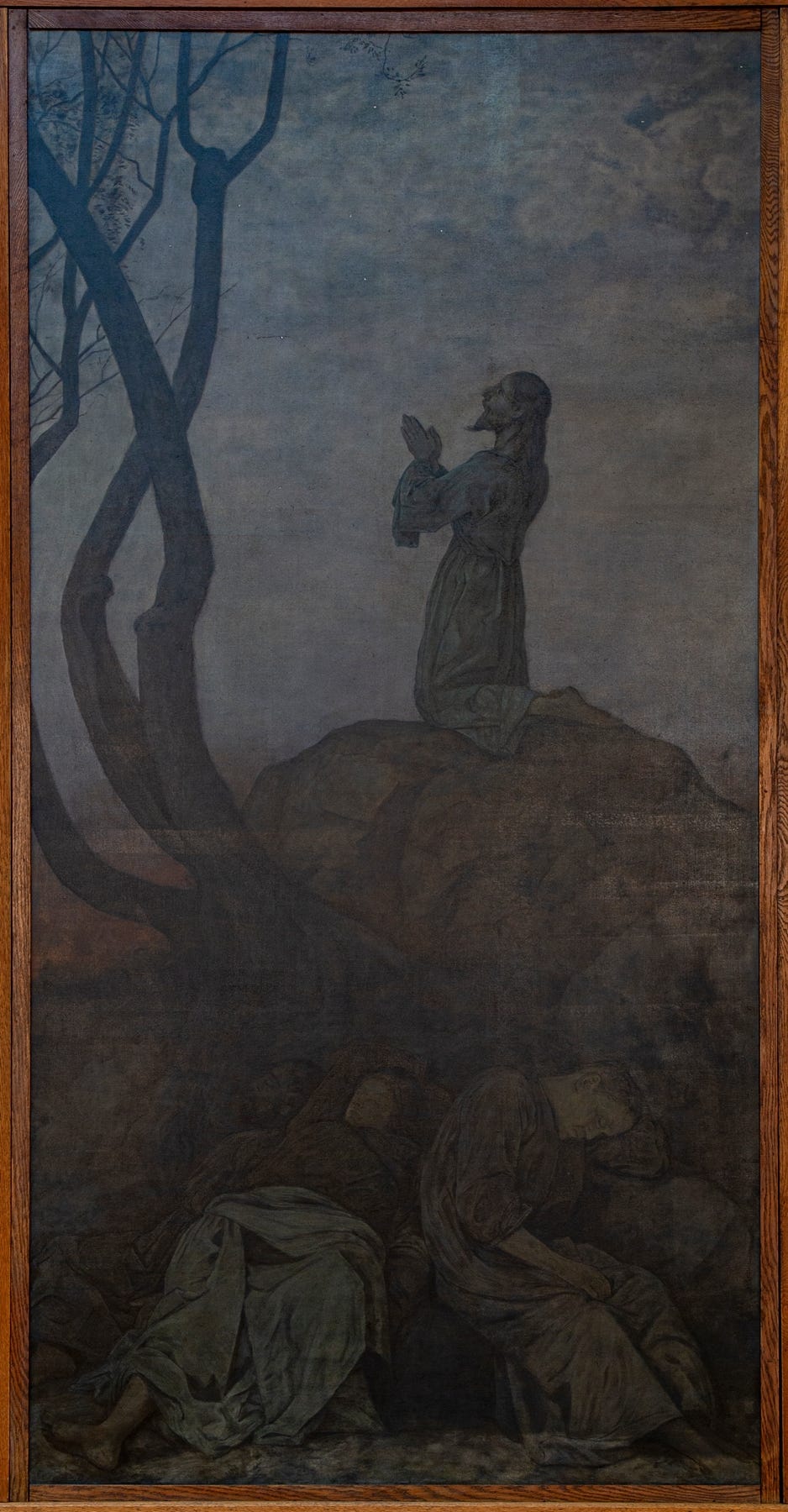
Many find it strange that I doubt the supernatural claims of the New Testament yet attend church every Sunday and enjoy it. Rudolf Bultmann’s 1941 essay “New Testament and Mythology” nicely articulates what I have long practiced intuitively. Bultmann argues that the mythological elements of the New Testament must be demythologized. But not discarded—instead, reinterpreted. The story of Jesus walking on water, for instance, is not a literal account, but a symbolic one, pointing toward something true about faith and human life even if it never happened.
I won’t go as far as Bultmann in claiming what Christianity as a whole ought to believe. But I do think Christians should be more accepting of people like me. My experience on Substack suggests they are not, at least not in large numbers. When I have written openly about my doubts regarding the supernatural claims of the New Testament, the response has often been somewhat hostile. You are not a Christian, I have been told, sometimes with considerable heat. But, there are Christians here who do accept my position, and I am grateful for them. They feel like the minority though.
I have no hard data to support what follows, but I am confident in it nonetheless: if you asked most Christians whether a person could belong to the faith without believing that Jesus literally rose from the dead, the answer would be no. For many, that belief is required. While I understand that position, I think it is worth interrogating.
Here’s a thought. Consider the Native American communities that still perform their traditional dances, songs, and ceremonies. These were religious practices, directed toward gods and spirits, intended to give thanks or seek intercession. Many of the people performing them today are Christians. Some are atheists. And yet no one finds this strange. In fact, most people consider it admirable. We understand intuitively that a person can participate in the rituals of their ancestors without sharing their ancestors’ cosmology. The practice carries something worth preserving: heritage, identity, continuity, a sense of belonging to something larger and older than oneself.
I find myself in a similar position with Christianity. I was raised in the tradition. It is the religion of my ancestors. The rhythms of the liturgical year, the language of the Gospels, the act of gathering with a community on Sunday morning, these are not empty to me simply because I do not read the miracle stories as history. I find meaning in the practice itself. I value the ethics at the center of Jesus’s teaching. I appreciate the sense of community the church provides, and the discipline of showing up, week after week, to reflect on how one ought to live.
There is also something simpler at work, something closer to beauty than to belief. I find the church building itself beautiful. The incense, the candles, the way light moves through stained glass. I find the language of the Bible and the old creeds beautiful too, the cadence of the Nicene Creed, the poetry of the Psalms, the grandeur of the prologue to John’s Gospel. I do not think this is a small thing. I think beauty is one of the ways truth announces itself, even when the truth in question is not historical fact, but something closer to how a people made sense of their world. And I should say this plainly: I want there to be a god. I pray, to him and to Jesus, more often than my doubts would suggest I should. I am not sure the prayers do anything. I am not even sure anyone is listening. But I say them anyway, because some part of me hopes I am wrong to doubt.
When I went through the RCIA process to become a confirmed Catholic, I recall saying that I saw Catholicism as my vessel toward God. I’m convinced that Jesus never actually walked on water or performed any of the other miracles in the New Testament. I’m less convinced about whether there’s a god at all. But, as I said, I want there to be one. What I am convinced of, regarding god, is that if he exists, he is either not almighty or not good. I feel this way because of all the suffering and evil in this life. This is a common reason for people to doubt god’s existence, and while Christians have responses to it, I have yet to hear one that solves the problem for me.
The most common response is that god gave life forms free will, and with free will, particularly in the case of humans, the consequence is that people will do evil things and cause suffering. But this doesn’t hold up for me, because the same Christians who use this argument also believe god intervenes in the world all the time. If that’s true, I don’t see how free will would prevent god from stopping evil. He could stop all of it and still leave free will intact.
A better way to resolve the problem, I think, is to argue that god isn’t all-powerful. He would like to stop evil, but he can’t. There’s also the possibility that god is indeed almighty but not good, which is why he doesn’t intervene. That thought unsettles me, and I hope it’s wrong.
Both of these views go against Christian belief. The average Christian will claim that god can do all things and is good. Similar to my views on Jesus’s miracles, I suspect most Christians would say I can’t call myself a Christian without sharing those beliefs.
Here is a summary of my Christianity. I do not believe Jesus walked on water, rose from the dead in a physical sense, or performed any of the other miracles attributed to him, though I believe his earliest followers were sincere in thinking he had. I am not sure a god exists at all. And yet I want there to be a god. I pray anyway. I go to church every Sunday, and I find real beauty there, in the building, the incense, the language of the Bible and the creeds, beauty that feels like its own kind of evidence even when I cannot follow it all the way to belief. I find meaning in the liturgy, the ethics, the community, and the discipline of showing up. I was raised in this tradition, and I choose to remain in it, the way a person might return to the dances and songs of their ancestors without sharing their ancestors’ beliefs about the gods those dances were meant to please. Beyond all this, I have a deep interest in the history of Christianity itself. Not just the historical Jesus, though that fascinates me most, but the complex, human process by which early Christianity took shape. How the movement split and argued with itself in its first centuries. How the books of the New Testament were written, debated, and eventually canonized.
I know some Christians will read this and conclude that I am not one of them. I understand why. But I think this view, doubt about the supernatural, uncertainty about god, hope alongside that doubt, and genuine commitment to the practice and beauty and ethics of the faith, should have room within Christianity. Belief has never been a single fixed thing. It has always been argued over, reshaped, and reinterpreted, from the earliest church councils to Bultmann’s demythologizing to whatever comes next. I am not asking Christians to believe what I believe. I am asking them to accept that a person can sit in the pew, take communion, and still doubt, still hope, still pray without certainty, and that this does not make him any less a part of the thing they are all trying to practice.
Thank you for a beautiful and honest text. My view is that no one can define whether you are a Christian or not, that is between you and God. One of Jesus’ core teachings is not to judge, and that includes not judging another person’s faith if you ask me.
I recognize the elements of your Christian practice. The main difference may be that I do believe in God based on mystical experiences I’ve had. Over time I’ve stopped trying to understand God, because the intellectual image of God often stands in the way of my lived experience. Instead I try to “feel” God, to let go, and let God shepherd me along the narrow path that leads to life.
I trust what Jesus teaches in Luke 6:43–45: you know a good tree by its fruit. When I look at my own life, I try to do what yields the fruit that Paul describes in Galatians 5:22–23, where love is the one that matters most to me. Those are the signs by which I recognize God’s presence in me and in the world. Not in definitions or belief, but in what grows in me.
Keep up the good work. Looking forward to reading more from you.
I think two words you use this essay, denote precisely the tension that you experience: belief and practice. Most Christians I encounter belief that Christianity is a belief system, one that results in a certain set of orthodox practices, like going to church, like participating in the liturgy, like taking the sacraments. That is one kind of Christian. And those Christians have a tendency to reject anyone who doesn’t believe as they believe, and practice as they practice. But there are others, such as yourself, such as perhaps even myself, that believe that belief begins with the practices themselves. The practices are the root, not the belief, and the practice is rooted in the beliefs that manifest from practices themselves. That type of Christian tends to be more open minded, tends to be more accepting, tends to be more inclusive.
I know that sounds a little circuitous. I hope you’ll excuse the lack of sophistication in the way that I’m explaining it.
But perhaps you understand all the same. The sum of it for me is that some Christians require orthodox belief and others require orthodox practice, or orthopraxis.
Most of the Christians I know on Substack are orthodoxy over orthopraxis. But there are a few, such as yourself, such as myself, I get believed that the most appropriate way to follow Jesus is to do the things that he did not simply believe things about him that he never talked about.