
Judas

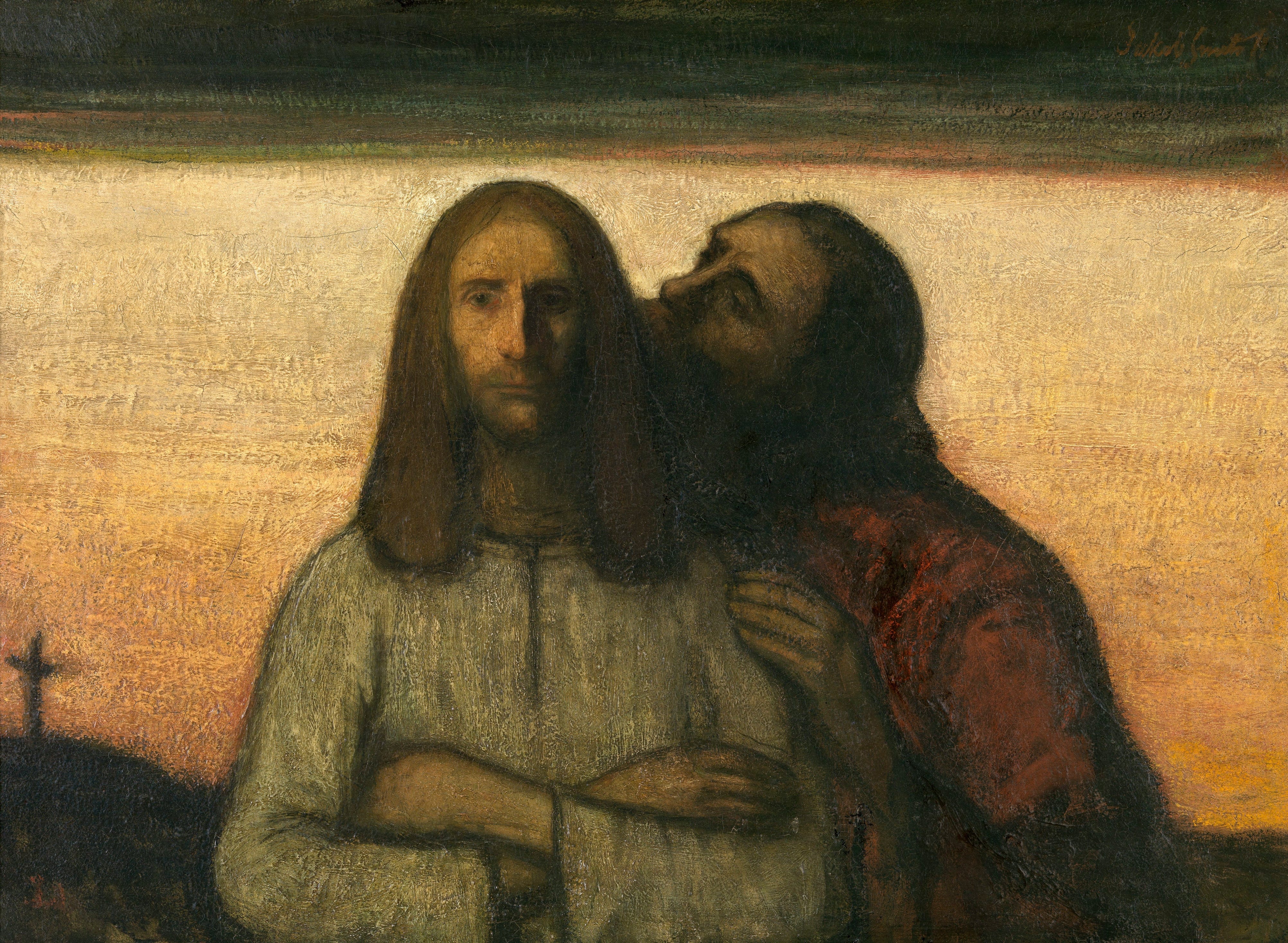
Jakob Smits- The Kiss of Judas (1908)
The parking lot was slush and salt. I sat there with the car running, arguing with myself. I had been sober for three months and eleven days, if you’re counting, and I was counting.
Eventually I went inside. The bottles shined like arcane trinkets. I chose gin, which was unlike me. Just to try something new. Somehow that made me feel a little less guilty. Normalized it or something.
I drove home through the gray rows of suburban houses, past two does foraging in the gray cold, down the street cloaked in gray. I sneaked up the stairs and locked the door. The bottle on the desk in front of me—my everything entire. I remember sitting there, just staring at it for a few moments before I began.
This was my greatest betrayal.
The most famous betrayal in the history of mankind is Judas’ betrayal of Jesus. What’s interesting is that this is one of the most widely held aspects of Jesus’ life as being historically accurate. Here’s why: It’s attested across multiple independent sources (the Synoptics, John, and Paul) and it’s a really bizarre thing to make up. Judas was one of the Twelve. Why would you invent a story where your messiah is betrayed by one of his own?
What has always felt invented to me was Jesus being aware that someone was going to betray him. The predictions, the “one of you will betray me” at the Last Supper—these feel like the community processing trauma through narrative, making sense of senselessness by framing it as foreknown.
I think the historical Jesus had no idea he was going to be betrayed.
But perhaps the more interesting question is not whether Judas betrayed Jesus, but how. Bart Ehrman mentioned in his podcast that some scholars think Judas betrayed Jesus by testifying to the Romans that he claimed to be a king—a capital offense under Roman law. They’ve come to this conclusion in part because the Gospel accounts seem suspicious. In the Gospels, Judas betrays Jesus by revealing his location. But Jesus had been preaching publicly in the temple. You didn’t need to pay someone thirty pieces of silver to point out where he was.
I’ve always found their suspicion strange. The Gospels give a plausible explanation—it was to prevent a riot. If they arrested him in secrecy it would lessen the chances. I tend to carry a philosophy of trusting the Gospel accounts when they’re describing something plausible, something that doesn’t serve an obvious theological agenda.
The truth is the authors of the Gospels, as well as those who passed the stories down before them, probably didn’t know the full reasoning behind the nighttime arrest. The Gospels say it was to prevent a riot, which could be the case, but that was probably their speculation. The only people who would have known the exact mechanics—Judas and the authorities—weren’t the ones telling the story to the early church.
And then there’s the question of motive. Why did Judas do it? Mark doesn’t say. Matthew suggests greed. Luke says Satan entered him. John says both greed and Satan. If Satan entered him, that raises the uncomfortable question of culpability. If Satan made him do it, was it really his fault? Or is demonic possession just the ancient world’s way of saying he did something inexplicable, something that seemed to come from outside himself?
What we can say with reasonable confidence: A man named Judas Iscariot was among Jesus’s closest followers. He betrayed Jesus to the authorities in a manner that facilitated arrest. The early Christian community remembered this with shame and anger and confusion and the kind of specificity that suggests trauma. They tried to explain it and couldn’t, not really. They just knew it happened.
I drank until I could barely stand. The blissful feeling that people get when they drink had long been extinguished. I remember the taste of fir trees and vomit. Regret. Cigarettes. My greatest betrayal. I don’t know if I’m good enough to have anyone other than myself as my Judas. I wish it had felt like Satan entered me but it didn’t.
I wrote poems and they were really bad. Maybe I’ll share them with you sometime.
What I’m saying is that it was all really humiliating, even though no one, not even God I don’t think, was watching. Can you blame me for trying to connect it to the New Testament, some means of glorifying it?
The difference, of course, is that Judas’ betrayal became part of salvation history. Mine just became another Tuesday. Not every betrayal gets redeemed into meaning. Some just sit there on your desk, half-empty, smelling of juniper and failure. The early Christians tried to narrativize their trauma and couldn’t fully succeed. I’m doing the same thing now, reaching across two thousand years for a pattern that might not fit. But we do what we can with our betrayals. We tell stories. We make comparisons. We try to convince ourselves it meant something.
The next morning, I poured what was left of the bottle down the drain.
This piece really captures the weight of personal betrayal and the human struggle to find meaning in our failures. I loved the way it parallels Judas’ betrayal with our own missteps—reminding us that not every failure is redemptive, yet reflecting on them is part of growth. The honesty here, the acknowledgment of shame and the act of letting go, feels deeply true to the human experience.
One second note. Satan, the adversary, is described in Deuteronomy chapter 15, as “the wicked thought”, which I render as the sociopathic mentality of power structures develop developed outside of Torah, what the theologians would call a Gentile.
In other words, Satan isn’t an external force, it’s the entropic force already existing inside of us, tempting us, luring us, seducing us away from the covenant and toward wealth and power and fame and ego.
This is what Yehoshua squared off against in the Judean wilderness, after his Qumran initiation was complete (Luke 4): not an external, pitchfork-wielding “Devil”, but “the wicked thought” tempting him away.
What does Yehoshua say to each temptation? A quotation of Deuteronomy. It’s not a coincidence. It’s the proving ground that demonstrates he was authorized, the Messiah, to bear the name, YHWH, and to initiate the emancipation project prescribed in the Torah, called the Yovel (Jubilee).
Satan is steady possessing us, brother. That’s the problem! It’s like an addiction, as you seem to understand. We don’t stop being addicted to ha-Satan, we fight it every day: in ourselves, our families, our communities, and so on.
We can cultivate that scarcity mentality, that entropic, sociopathic thought process and mental framework, or we can choose to align and a tune ourselves to the Covenant.