
Jesus and the Wilderness

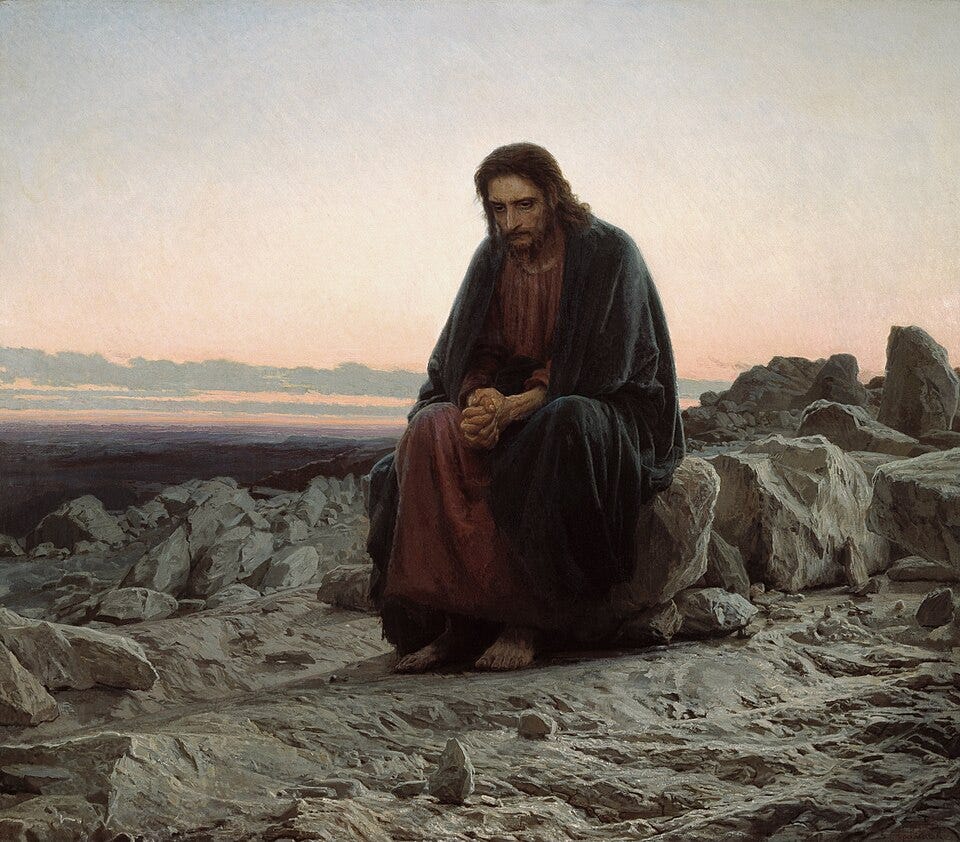
Ten days ago something bad happened to me. The details don’t matter, but it led to a state of despair and reflection. And as has always been true of me in such moments, I turn toward the wilderness. After graduate school I moved to rural Alaska and lived with the Yupik people so I could escape academia and become closer to the wild. Such a behavior actually appears to be rather Christ-like. Observe:
But now more than ever the word about Jesus spread abroad; many crowds were gathering to hear him and to be cured of their diseases. Meanwhile, he would slip away to deserted places and pray.
—Luke 15-16 NRSVUE
In the morning, while it was still very dark, he got up and went out to a deserted place, and there he prayed.
—Mark 1:35 NRSVUE
Now when Jesus heard (of John the Baptizer’s death), he withdrew from there in a boat to a deserted place by himself.
—Matthew 14:13 NRSVUE
If you go deep enough into the wilderness, there is no one there to be ashamed of you. It is not just the silence that provides consolation, but the erasure. You are not a man with a history there. You are just another animal moving through. I wonder if the historical Jesus felt similarly.
But while you may have escaped the world of man, you have not escaped the world of spirits. You have not escaped God. And perhaps, you have not even escaped Satan. Mark tells us that after Jesus’ baptism he was taken into the wilderness by the Spirit, and Satan was there, waiting.
And the Spirit immediately drove him out into the wilderness. He was in the wilderness forty days, tested by Satan, and he was with the wild beasts, and the angels waited on him.
—Mark 1:12-13 NRSVUE
Matthew and Luke expand the scene. Satan comes to Jesus three times. He offers food, power, and the proof of God's protection. Jesus refuses each one.
I’ve always suspected that this scene comes from the historical Jesus himself, and was passed down by his disciples until it reached the author of Mark. It is possible that Mark invented it, and I don’t know how I might prove otherwise—but there is something about it that I can’t quite identify that doesn’t feel like literary invention, but tradition passed down.
The historical Jesus must have spent a considerable amount of time in the wilderness. As far as I know, all historians are in agreement that Jesus was a preacher who traveled from town to town throughout rural Galilee.
And travel between those villages was not quick or comfortable. The roads were dirt tracks through open country, and a man on foot covered perhaps twenty miles on a good day. Jesus and his companions would have spent hours alone between towns, surrounded by nothing. And then we have multiple accounts from the Gospels of Jesus withdrawing alone to the wilderness. I suspect this tendency of his is historical.
Two days ago there were tornadoes here in Mississippi. When the rain finally cleared I took my four Alaskan dogs to De Soto National Forest. Someone dumped a bunch of roosters on the trail and after Charlotte chased one I fed them oatmeal.
I walked with a staff, as I suspect Jesus did.
I reflected on my mistakes. Tried to make sense of them. If there is a Satan, he was there, and he encouraged me to relapse. If there is a God, he was there, and he did not turn away, though I have given him every reason to.
Old rain dripped from the leaves. The skull of a deer lay there with ferns growing through the eye sockets. There are answers in the wilderness. Find them.
The path to deep faith runs through the forest of failure
All the best, Joseph! A wonderful and timely reflection. Thank you for returning to the fray with a gift for all of our nervous systems: a reminder that solitude, too, is holy.