
Jesus and Animals

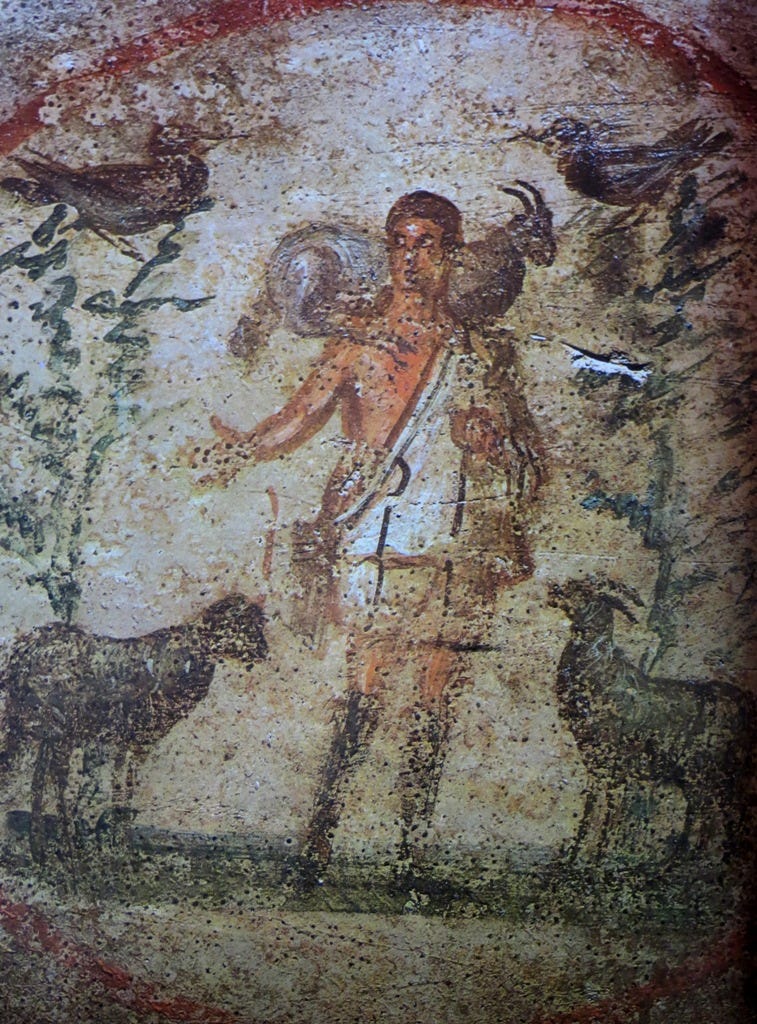
I’ve always been disappointed that there aren’t more animals in the New Testament. There are few instances where Jesus has significant encounters with them. Mankind’s relationship with the animal kingdom is not a prominent theme of the New Testament. Actually, it’s hardly a theme at all. Many argue, with good reasoning, that Jesus was immensely compassionate toward people, particularly the poor and sickly. I wonder if this compassion extended to animals as well. It may be fair to assume, but it’s difficult to prove with textual evidence.
We see a few instances of it.
Are not five sparrows sold for two pennies? Yet not one of them is forgotten in God’s sight.
—Luke 12:6 (NRSVUE)
He said to them, “Suppose one of you has only one sheep and it falls into a pit on the Sabbath; will you not lay hold of it and lift it out?
—Matthew 12:11 (NRSVUE)
And then of course there is the famous scene where Jesus enters the temple and overturns the tables of those selling doves. In the Gospel of John, Jesus makes a whip of cord and drives out the sheep and the cattle too.
But were these actions at the temple motivated by compassion for animals? I don’t think the text really suggests so. Instead, Jesus seems to be critical of the temple as a marketplace, of commerce displacing prayer and worship.
There is also a moment in the Gospels where one could argue Jesus shows a lack of compassion for animals. The demons that possess the man of Gerasene ask Jesus to drive them into a nearby herd of swine, and he does so. This causes the pigs to throw themselves off a cliff.
When Jesus refers to dogs in the New Testament, he means people, used figuratively. Similar to lost sheep. I think there is only one instance in the New Testament where actual dogs are mentioned.
a poor man named Lazarus, covered with sores, who longed to satisfy his hunger with what fell from the rich man’s table; even the dogs would come and lick his sores.
—Luke 16:20-21 (NRSVUE)
But the fact that dogs were used as an ethnic slur toward Gentiles is perhaps telling of the Jewish view of them in the first century. Throughout biblical literature, dogs are portrayed as pests and scavengers, with scenes of them eating dead bodies. Sometimes they’re portrayed as dangerous. They’re never portrayed as companions. Herders of this time and place were likely using sheepdogs, though it’s difficult to say how these animals would have been seen and treated. What I’m getting at is that the historical Jesus probably wasn’t a dog lover.
I admit this disappoints me, as I would prefer a Jesus who loved dogs like I do. I used to live in the Yukon-Kuskokwim Delta with the Yup’ik people. Unfortunately, dogs are often treated horribly there. I could give you a whole list of horror stories, but I don’t want to upset you. It still haunts me to this day. I made an effort to save abandoned or mistreated dogs while I was there, shipping out around twenty-five dogs to Anchorage for adoption and adopting four of my own. Barbara, Charlotte, Ruth, and Mary.
When I look at the evidence, I find it very unlikely that loving dogs the way I do was at all common among first-century Jews. However, that doesn’t mean Jesus didn’t have compassion for them. Did he have one as a pet? Probably not. Was he kind to them? He could have been.
Ultimately, I think it’s difficult to argue one way or the other about Jesus’ treatment of animals from the Gospels alone. This is why I was surprised to learn that some respected historians have presented the argument that Jesus was a vegetarian. James Tabor may be the most notable of supporters of this theory.
I’d seen the idea brought up a few years ago, but didn’t give it much attention. It sounded like another shoddy argument, the kind where a scholar builds a case that Jesus’ ethics are the same as his. That sort of thing is actually quite common. The theory received so little attention that I assumed it hardly deserved any.
But recently I looked into it more carefully. I’m not fully convinced, but the evidence is stronger than I had expected.
One strand of evidence is that James, Jesus’ brother, is recorded as having been a vegetarian. Eusebius quotes Hegesippus, who was writing somewhere around the mid to late second century. The quotation reads:
James, the Lord’s brother, succeeds to the government of the Church, in conjunction with the apostles. He has been universally called the Just, from the days of the Lord down to the present time. For many bore the name of James; but this one was holy from his mother’s womb. He drank no wine or other intoxicating liquor, nor did he eat flesh; no razor came upon his head; he did not anoint himself with oil, nor make use of the bath. He alone was permitted to enter the holy place: for he did not wear any woollen garment, but fine linen only.
—Ecclesiastical History 2:23
One might argue that if James was a vegetarian, there’s a decent chance Jesus was too. Keith Akers takes it a step further. He asks: why would Jesus’ family raise James as a vegetarian but not Jesus?
What I think is the strongest strand of evidence is the Ebionites, who are recorded as having been vegetarians. The Ebionites were a Jewish-Christian sect from the first few centuries after Jesus. They kept the Jewish law and saw Jesus as the messiah. We know they were vegetarian from Epiphanius, a fourth-century bishop who wrote against groups he considered heretical. He says it plainly. He also quotes their gospel, and the quotations give it away on their own. Where Mark and Matthew have John the Baptist eating locusts, the Ebionite gospel has him eating honey cakes instead. It’s a small change, but it looks deliberate. We also have fragments where Jesus does away with animal sacrifice himself. The text has him say:
I am come to do away with sacrifices, and if you cease not sacrificing, the wrath of God will not cease from you.
Some argue that the Ebionites’ understanding of Jesus was closer to the original than that of the tradition that became dominant. Proponents of this theory often argue that much of the New Testament is a Hellenized version of Jesus’ life and message. They believe Jewish-Christian sects, like the Ebionites, better preserved what Jesus actually taught.
This is not quite a fringe position. The argument is that the Christianity enshrined in the New Testament represents a significant departure from what Jesus actually taught and practiced. Paul’s tradition won. James’ tradition lost. What got written down, canonized, and declared scripture was largely shaped by a gentile Christianity that had already moved away from the original movement. Mark declares all foods clean. Luke has the risen Jesus eating fish. If Akers and others are right, these aren’t straightforward records of what Jesus said and did. They’re theological arguments in narrative form, written by a tradition that had reasons to put distance between itself and the vegetarians of the Jerusalem church. That’s a bold claim. If vegetarianism was dropped from the record, it wasn’t a small revision. It would mean the New Testament, as we have it, gives us something quite different from the religion of Jesus.
Akers argues that we can also see anti-vegetarianism in Paul’s letters, and that this means vegetarianism was prominent enough among first-century Christians that Paul felt compelled to argue against it. The relevant texts are Romans 14 and 1 Corinthians 8-10. In Romans, Paul refers to those who eat only vegetables as weak in faith:
Some believe in eating anything, while the weak eat only vegetables.
—Romans 14:2 (NRSVUE)
Taken together, these three strands build a case. James was vegetarian. The Ebionites were vegetarian. Paul argued against vegetarians. None of this proves Jesus was a vegetarian, but it makes the theory stronger than I initially thought.
Akers also returns to the temple clearing, and what he does with it is worth taking seriously. Earlier in this essay I argued that Jesus’ actions there were motivated by opposition to commerce in a sacred space. Akers sees it differently. The animals being sold were sacrificial animals. The buyers and sellers were the infrastructure of the animal sacrifice business. When Jesus drives them out, Akers reads this not as an objection to a marketplace, but as a direct attack on animal sacrifice itself. He points to Matthew 12, where Jesus quotes the prophets: I desire mercy, not sacrifice.
Here’s what I keep thinking about. Say Tabor and Akers are right: the historical Jesus was a vegetarian. And say it was indeed recorded in all four Gospels. Can you imagine how different the world would be? We’d probably all be vegetarians. Maybe holy wars would have been fought to liberate animals from meat-eating nations.
I’m still not convinced. The evidence is circumstantial. The sources are late. The canonical Gospels tell a different story. Mark has Jesus declaring all foods clean. Luke has him eating fish after the resurrection. But what I can say is that I no longer find the argument shoddy. And for someone who has spent all his life caring about animals, I’ll admit there’s something in the possibility that I can’t quite shake. And I remain disappointed that the New Testament has so little to say about our relationship with animals. I’d love a scene where Jesus heals a hurt dog, or scratches a cat’s chin.
You’ll love this. In Mark 1:13 we have recorded “…[Jesus] was in the wilderness forty days being tempted by Satan; and He was with the wild beasts, and the angels were ministering to Him.”
I always like to imagine that Jesus was calming the wild beasts with his peaceful presence. Just as Adam named and walked with the animals in Eden, so the second Adam communed with them in the wilderness, even as a cosmic battle for creation (represented by the animals) was ongoing between Satan and the ministry of the angels.
He certainly didn't care for pigs, not in the Holy Land anyway - MATT.8:32. There seems to be no record that YESHUA ate meat or fish or drank wine Himself.